
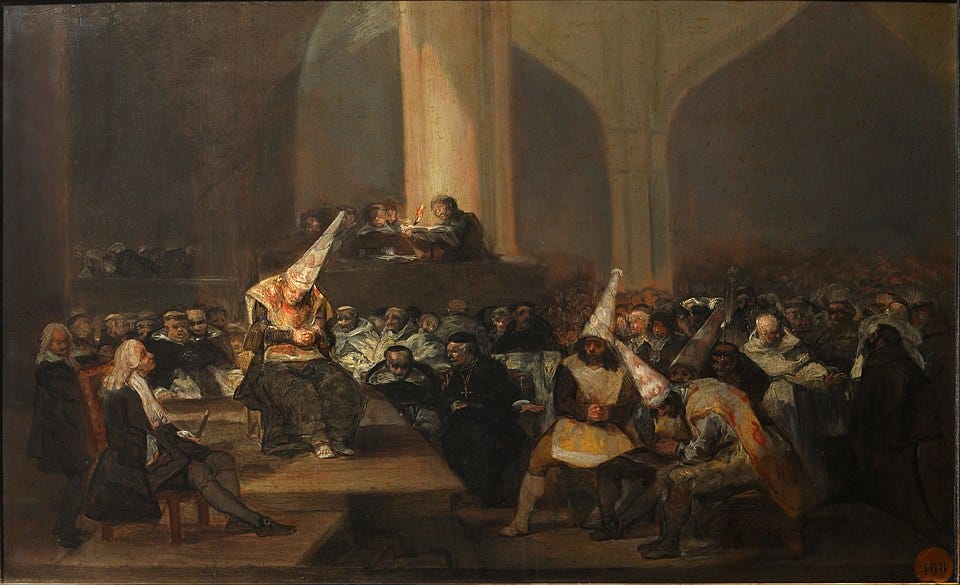
“Study the historian before you begin to study the facts.” - E. H. Carr, What Is History?
In 1993 Eric Hobsbawm, argued in the New Threat to History, that “history is the raw material for nationalist or ethnic or fundamentalist ideologies,” in the same way that poppies are the raw material of heroin, and that where a movement cannot find a suitable past to serve its purposes, it will invent one. Hobsbawm admitted that he had once believed history, unlike nuclear physics, was a profession that could at least do no harm, and that events had taught him otherwise.
The historian’s obligations, as he came to see them, were first to verifiable fact and then to the exposure of the political and ideological abuse of history wherever it appeared. That this warning came from one of the most celebrated Marxist historians of the twentieth century should dispel any suspicion that it belongs to one side of politics. It describes a danger that arises whenever a political programme needs the past to testify on its behalf.
Herbert Butterfield had even identified the mechanism of that abuse six decades earlier. In the Whig Interpretation of History, he described historians who arrange the past so that it culminates in, and thereby ratifies, the political arrangements of their own day. He called the habit of studying the past with one eye on the present “the source of all sins and sophistries in history.” His targets were the Whig historians who narrated English history as a steady ascent toward parliamentary liberty. The Caribbean reparations narrative is a Whig history in reverse. It arranges three centuries of Atlantic history (the slave trade, emancipation, Crown Colony rule, the Moyne Commission, independence) so that every episode leads toward one present conclusion, that Britain owes the Caribbean a debt, and it treats any evidence that declines to lead there as illegitimate. Hilary Beckles, as I have discussed before, the narrative’s principal propagandist, has described the economic historians who dispute its foundations as producing “a literature of scholarly denial.”
When an institution with authority over the education of the young takes one side of a live political dispute and teaches it as the settled conclusion of historical inquiry, it has converted the discipline into an instrument of political formation. The danger is gravest when the position being taught rests on premises the evidence contradicts, and when the students receiving it are too young to have encountered the counterevidence and too dependent on the qualification to risk contesting it. The Caribbean Examinations Council (CXC) has now done precisely this.
Since 2018, and with the most recent update implemented for teaching this year, CXC tests students across the region on a revised CAPE Caribbean History syllabus, the Caribbean’s equivalent of A-Level history in England. It explicitly lists among the aims of the course the development of a “commitment to social justice (including reparatory justice).” It devotes a sub-theme to the “Movement for Reparatory Justice (1990s up to 2020),” schedules that sub-theme as the examined topic for the Unit 2 written paper in 2035, and recommends Beckles’s Britain’s Black Debt as a resource. The syllabus in force in 2011 when I was in secondary school in Barbados, did not mention the word reparations even once.
Study the Historian
Carr’s advice to study the historian before studying the facts applies to this syllabus with unusual force. As I recounted in a previous blog, when I sat Caribbean History, the textbooks that shaped my initial understanding of the region were written by Beckles (History Ph.D. from the University of Hull) and Verene Shepherd (History Ph.D. from the University of Cambridge), and to my mind at the time their two volumes, Liberties Lost and Freedoms Won, were the gold standard of clarity. Then I reviewed Beckles’s two books on reparations, Britain’s Black Debt and How Britain Underdeveloped the Caribbean, and concluded that the case for British reparations to the Caribbean could not be justified on historical, economic, theoretical or philosophical grounds. What I did not then appreciate enough was how thoroughly the “scholars” who built that case also control the channels through which the next generation learns about it.
I did point out that Beckles has served as Vice-Chancellor of the University of the West Indies and chaired the CARICOM Reparations Commission, the body that drafted the region’s formal demands on Britain. Shepherd has directed UWI’s Centre for Reparations Research, and she co-wrote the introduction to reparation for secondary schools that the new syllabus recommends. Their edited volume Caribbean Slavery in the Atlantic World sits among the core readings for the syllabus’s opening Module on the philosophy and method of history. But crucially, Beckles was elected Chair of the Caribbean Examinations Council since 2020. The historians who define the syllabus’s account of reparations are, in other words, the leaders of the political campaign for reparations.
How a Political Demand Is Converted Into Historical Fact
The process by which the syllabus turns a policy position into historical truth takes several steps, each modest in isolation and decisive in combination. The first is the aim itself. By placing reparatory justice inside its definition of social justice, CXC has made support for a particular policy a component of moral seriousness. A student who concludes, on the evidence, that reparations are unjustified has therefore failed, by the course’s own stated standard, to develop the values the course exists to instil. The same document asks students to “differentiate among historical facts, opinions and biases,” a skill it renders unusable on the one question where it would matter most.
The second step is the selection of evidence, and here the syllabus’s gesture toward balance is instructive. It does list eight arguments against reparations, set out the way a prosecutor summarises the defence before dismissing it. One is recorded simply as “Squandermania.” Another reads “Caribbean governments should seek to develop in the present,” which is the thesis of my 2023 essay compressed into eight words and abandoned there. No text on the reading list develops any of the eight. The arguments for reparations arrive with an entire apparatus of supporting material. The recommended resources include Britain’s Black Debt; Randall Robinson’s The Debt; Ta-Nehisi Coates’s “The Case for Reparations”; the Shepherd introduction for schools; lectures by Beckles and Ray Winbush; Shashi Tharoor’s Oxford Union speech; and a music video titled “Reparation for my soul.” There is no David Eltis, no Stanley Engerman, no Joel Mokyr, no DeLisle Worrell and no Nigel Biggar.
The third step is the objective that presents itself as critical inquiry. Students are asked to “critique the nature of the movement.” The content prescribed under that objective consists entirely of the organisations making the demand (the CARICOM Reparations Commission, the UWI Centre for Reparations Research, the Rastafari movement, the Repair Campaign and Heirs of Slavery), followed by the CARICOM 10-Point Plan. That plan attributes the region’s high rates of hypertension and type two diabetes directly to slavery and asks European governments to fund the “psychological rehabilitation” of Caribbean populations. A student instructed to critique a movement using only that movement’s own literature has been set an exercise whose outcome was fixed before he began it.
The final step is the examination, which converts instruction into compulsion. A student may privately doubt what he hears in a classroom. It is considerably harder to doubt what he must reproduce to earn the qualification that governs his admission to university. When he sits the paper, every source he has been trained to cite will point in one direction, and a candidate who wished to argue the other side would find no prescribed reading on which to build his answer. Embedded in the aims, the resources and the examined content of a regional qualification, a contested political demand acquires an authority no individual scholar could confer on it, and becomes simply what history says.
A False Premise at the Foundation
The economic core of the reparations case is Eric Williams’s thesis that the slave trade and Caribbean slavery financed British industrialisation, and the syllabus’s treatment of that thesis shows the method at its most revealing. Unit 1 presents it as a genuine historiographical debate, naming Lowell Ragatz, Roger Anstey, Seymour Drescher and Selwyn Carrington and asking students to weigh Britain’s internal sources of growth against Atlantic ones.
Even this debate is arranged to stop short of the economic historians who did the greatest damage to the thesis. Eltis and Engerman showed that in 1792, the peak year, 204 slave ships sailed from Britain out of more than 14,000 registered vessels, which placed the slave trade at under 3 percent of British shipping tonnage. They also found that West Indian sugar contributed under 2.5 percent of British national income. They posed a counterfactual that the reparations movement has never answered. Portugal’s Brazilian slave economy formed a far larger share of its Atlantic system than the Caribbean did of Britain’s, and by 1770 the French Caribbean produced more sugar, and many times more coffee and indigo, than the British islands, yet neither Portugal nor France industrialised first. Mokyr’s work locates the Industrial Revolution in engineering competence and the diffusion of useful knowledge, which leaves plantation capital with little explanatory work to perform.
By Unit 2, even that truncated debate has been abandoned. Among the arguments for reparations, the syllabus lists “British industrialization (Britain benefitted from enslavement)” as an established premise. A student who took Unit 1 seriously would recognise that premise as contested and, on the quantitative evidence, very probably false, and he is required to set that knowledge aside at exactly the point where it becomes relevant. Williams himself never called for reparations. CXC has taken his most disputed thesis, attached it to a political programme he did not endorse, and made the combination examinable as fact. This is Butterfield’s Whig error in its purest form, a historical claim retained because it serves a present purpose, whatever its standing in the scholarship.
The Evidence Struck From the Record
What the syllabus omits is as revealing as what it asserts, and the omissions follow a consistent pattern. Wherever the historical record complicates the story of pure extraction, the syllabus either halts its narrative just before the inconvenient evidence begins or removes the material altogether.
Its treatment of Morant Bay is perhaps the clearest case. The syllabus teaches the 1865 rebellion and lists, among its consequences, the abolition of the Old Representative System and the introduction of Crown Colony government, and at that point the narrative ends. Junius Olivier’s doctoral research at the LSE, built from the Colonial Blue Books, shows what followed. Once London dissolved the planter assembly that had governed Jamaica for two centuries and assumed direct control, public investment rose substantially, including spending on the health, education and infrastructure of the mass of the population. The planters had governed in their own interest, and the imperial administration, whatever its failings, invested in the people they had neglected.
A syllabus concerned with historical understanding would ask students to follow the consequences of the change it describes. This one stops at the date after which the evidence begins to cut against its thesis.
The syllabus’s own account of Barbados undermines it further. In describing the 1876 Confederation Riots, it records the planters defending their Old Representative System against the reforms proposed by Governor John Pope Hennessy, and it places the word “promoted,” describing his transfer to Hong Kong, in quotation marks. On the syllabus’s own evidence, the reforming force in 1876 was the imperial governor, and the obstacle was the local planter elite. Nowhere is the student invited to draw that conclusion, and nowhere is he given a reading that would help her draw it.
The Moyne Commission is handled with less scruple still. The reparations sub-theme lists the “Failure to finance the development of the Caribbean arising from the Moyne Commission Report” as a historical injustice, and elsewhere counts the Commission’s recommendations among the reasons for reparations. The Commission’s recommendations produced the Colonial Development and Welfare Act of 1940, which directed British funds into the region. Worrell (former Governor of the Central Bank of Barbados) concludes that the essential economic transformation of Barbados was achieved during the 1950s and 1960s, before independence. The island’s main hospital opened in 1964 and its deep-water port in 1961, both under colonial administration. Whether British funding was adequate is a question on which historians may reasonably differ. The syllabus settles it by decree and records the answer as a crime.
The most consequential deletion concerns the path the Caribbean did not take. The 2011 syllabus asked students to explain why the French Caribbean territories had not pursued independence, and it encouraged a classroom debate on the advantages and disadvantages of assimilation against independence. That was the single point in CAPE History at which a student might have met the most inconvenient evidence in Caribbean political economy. Feyer and Sacerdote find that each additional century of colonial rule is associated with roughly 42 percent higher income per head among island economies.
Armstrong and Read find that over 47 percent of dependent territories fall in the highest income band, against 18.6 percent of independent small states. Worrell observes that Puerto Rico, comparable to Jamaica in size and population, has an economy seven times larger. He adds that Martinique produces roughly twice the output of Barbados, and that the Cayman Islands, with a quarter of Barbados’s population, produces more. The 2026 syllabus deletes the assimilation debate entirely, together with the West Indies Federation, CARIFTA and CARICOM. A course that catalogues the costs of empire in detail while removing every comparison with the territories that remained inside it is presenting a verdict from which the exculpatory evidence has been struck.
The syllabus does concede, in its treatment of Africa, that European colonisation left a “positive legacy,” listing two items (infrastructure, and health and education) against four negative ones. It offers no comparable concession anywhere in its treatment of the Caribbean, which is precisely where the comparative evidence for such a legacy is strongest.
A Discipline Turned Against Itself
What makes the syllabus insidious, as opposed to merely biased, is that it borrows the authority of historical method in order to exempt its central claim from that method. Its opening Module focuses strongly on teaching students that historical accounts are are often subjective reconstructions, that revisionism is intrinsic to the discipline, and that honest historians working from the same sources reach different conclusions. Its written paper sample question asks candidates to reflect on “history as an argument without end.” There is some truth to this in the study of the philosophy of history. But taken to far it becomes a calling card for toxic historical relativism. The syllabus, having taught students that every historical conclusion is provisional, it then exempts exactly one conclusion from that principle, the one on which the region’s governments have a financial claim outstanding.
CXC’s syllabus writers plainly know how to present a contested question fairly when they choose to. The same document pairs Van Sertima’s claims of pre-Columbian African contact with Bernard Ortiz de Montellano’s rebuttal. It teaches the Russian Revolution alongside the Red Terror and the famine, classes Stalin’s Soviet Union as totalitarian, and lists American Cold War interventions next to Soviet ones. The treatment of Word War 1 lists Niall Ferguson’s exceptional book The Pity of War as a resource. The one-sidedness of the reparations material cannot therefore be excused as the ordinary compression of a school syllabus. It reflects a decision about which questions young people are permitted to treat as open.
The reading lists confirm that the decision runs along a single ideological line. Walter Rodney’s How Europe Underdeveloped Africa, the model for the title of Beckles’s own book, appears in Unit 2. Kwame Nkrumah’s Class Struggle in Africa is listed twice, and a profile of Nkrumah produced by the Chinese state-owned broadcaster CGTN is recommended viewing. The section on the Non-Aligned Movement presents Castro’s Cuba as “a leading voice of the Global South” and endorses the New International Economic Order. Nowhere in the course is a student given a text from the institutional or market-liberal traditions in development economics, where most of the serious comparative research on why some former colonies prospered and others stagnated has been done. Bruce Gilley’s observation, which I discussed in another blog, that anti-colonial scholarship too often served contemporaneous advocacy at the expense of accuracy, could stand as a summary of the whole design.
The Fatal Conceit, Taught in School
In my other blog I argued that the fatal conceit of the Caribbean reparations movement lies in governments seeking absolution by abrogating their responsibilities, preferring a rant about distant historical harms to difficult present truths about public sector capacity and fiscal discipline. Barbados’s public debt stood at 62.4 percent of GDP in 2006 and 146.9 percent a decade later, forty years after independence, and the island’s Auditor General reports year after year that the accounts of most state enterprises cannot be verified.
The damage extends well beyond a mistaken reading of the eighteenth-century British economy. A student taught that her country’s condition was manufactured abroad learns, by implication, that its remedy also lies abroad. He learns that the governments which have controlled Caribbean legislatures and treasuries for more than sixty years bear no primary responsibility for the debts, the unaudited public accounts and the stagnant growth he will inherit. No government could design a more effective means of insulating itself from the judgement of its citizens than to teach those citizens, while they are still in school, that their grievances belong elsewhere. That is the use of history as therapy Schlesinger warned against, and it corrupts the history in exactly the way he predicted.
The corrections are obvious, and any examinations council committed to the integrity of its subject would make them. CXC should remove “including reparatory justice” from the aims of the course. It should rebuild the sub-theme as a genuine debate, in which Eltis and Engerman, Mokyr, Drescher, Worrell and Biggar are read alongside Beckles and Coates. And it should restore the assimilation debate and the aftermath of Crown Colony rule, so that students can weigh the path the Caribbean took against the paths it declined.
Hobsbawm came to accept, late in his career, that the profession of history could do real harm. The new CAPE History syllabus shows how that harm is done, by teaching an ideology to young people with the authority of fact. If we are the ones who need to do the work at home, that work cannot begin while the region’s examination system teaches its students that the work belongs to someone else.
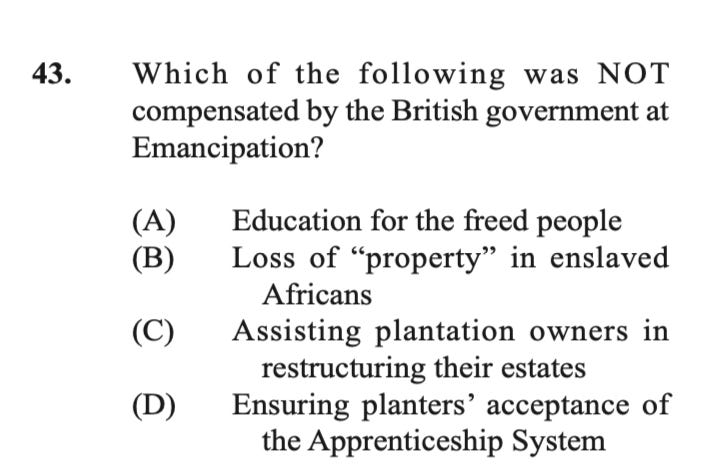
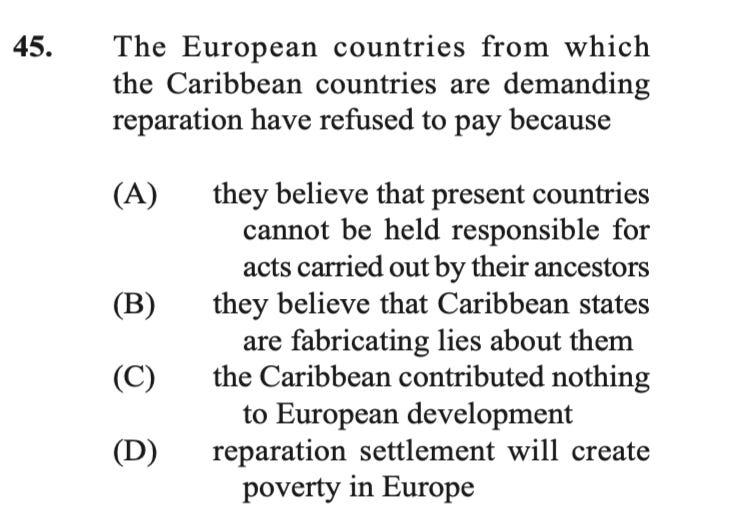
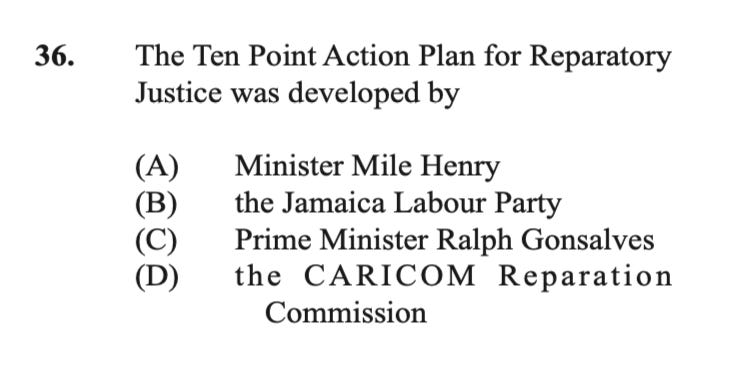
Here are some sample questions (multiple choice section) from the published syllabus:
Also, it would take me another essay to dissect the extent to which the standards for historical examination in the Caribbean have plummeted more generally. But take this sample question as a swan song:
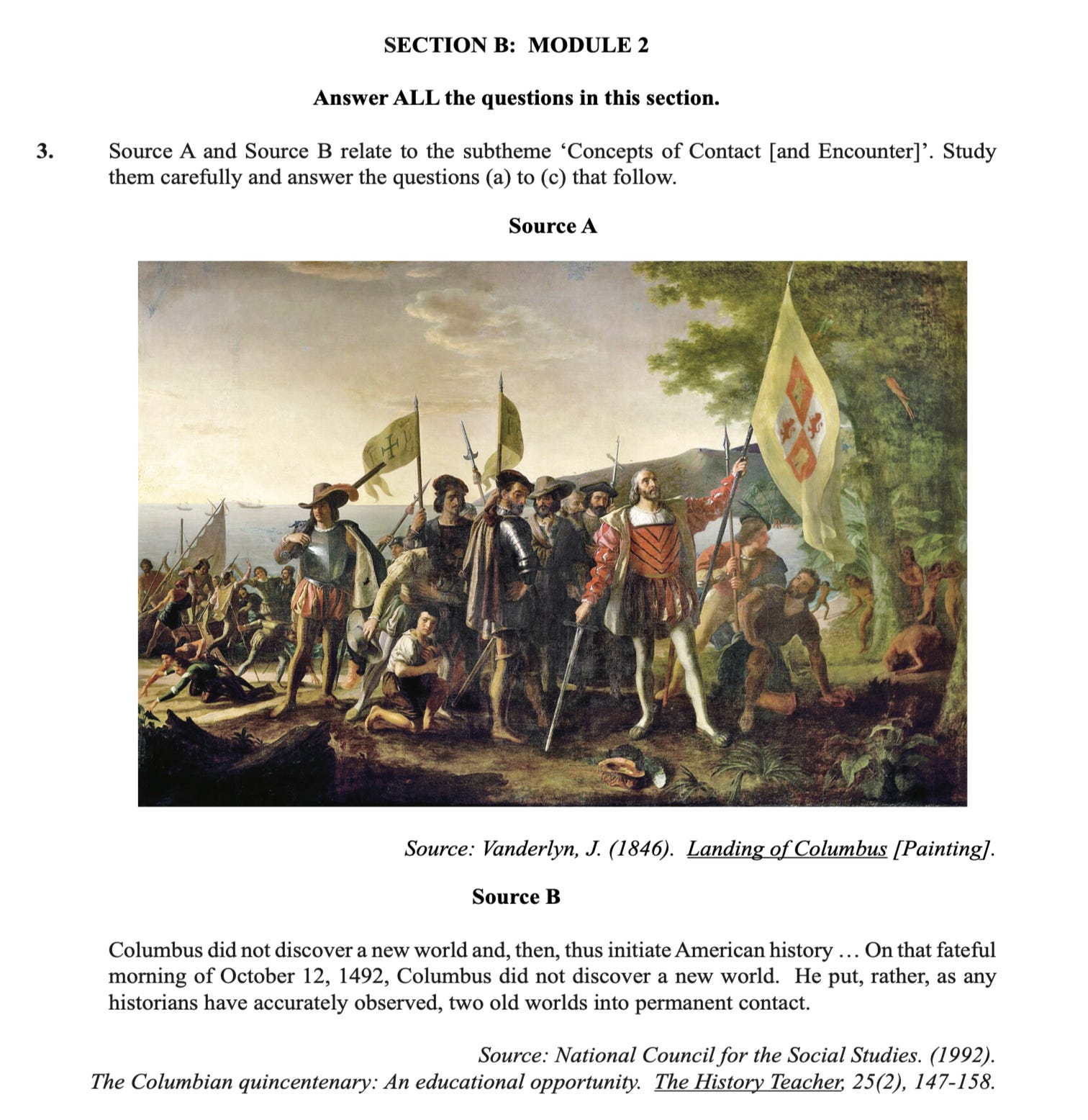
When I sat History, we marshalled dates and citations across long essays that left our fingers sore. Students now describe a painting in a paragraph.
This reminded me about how much I hated the CXC History obsession with the Haitian revolution (as opposed to the American or Bolivaran one) when Haiti was a failed state with the lowest per capita income in the Western Hemisphere. Not exactly successful was it ? Put me off history for at least 20 years .....