
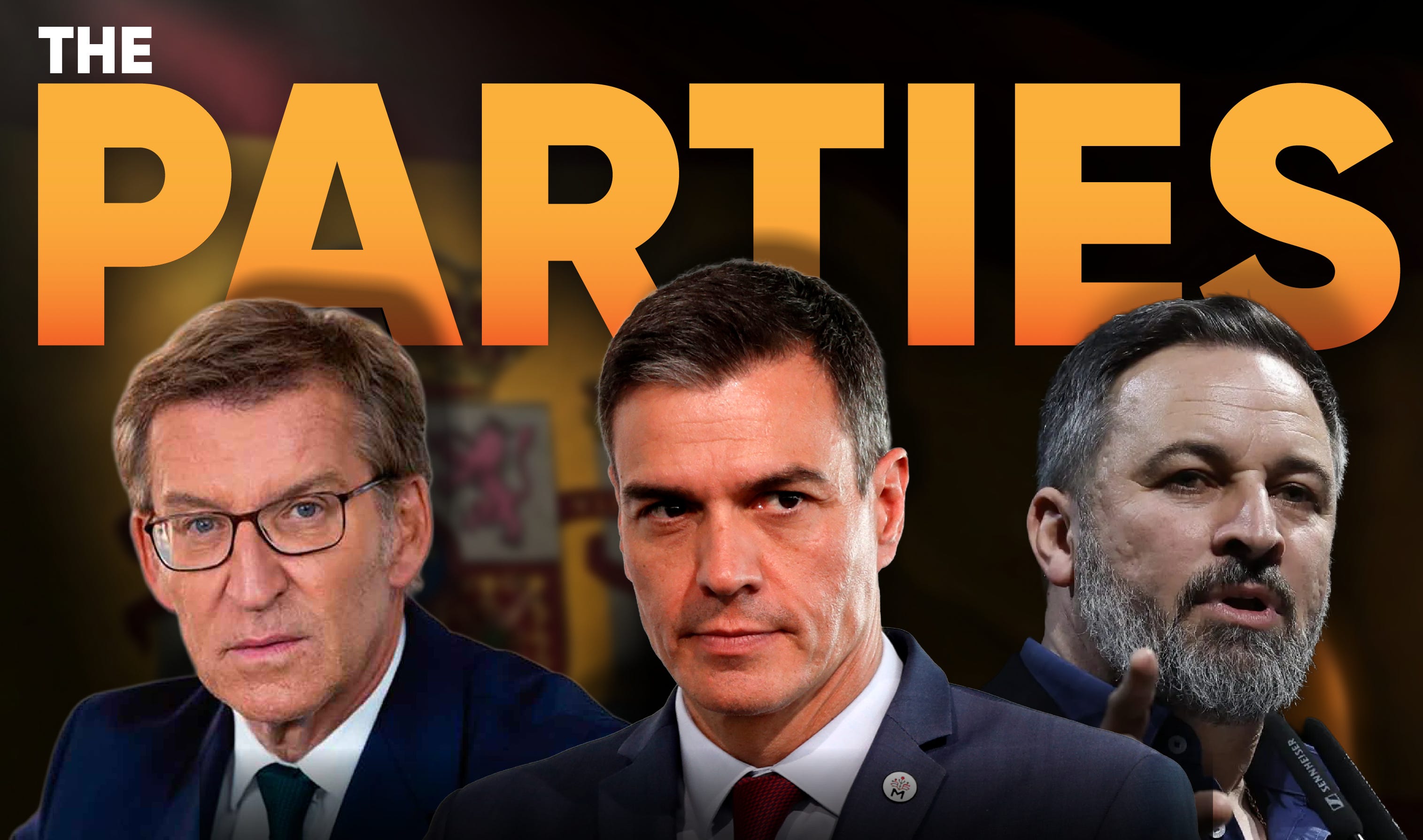
Spanish politics is weirder, more interesting, and more consequential than even the most well-informed outsiders are prepared to believe. Foreign readers tend to file Spain under tapas in Sevilla, Mediterranean sunsets in Mallorca, or the worn-out tropes of Civil War discontent. From that starting point almost nothing in the current elections campaign makes sense. Consider a few features of the Spanish system, any one of which would be the defining fact of politics in most European countries, and all of which hold in Spain at once.
The medieval map still votes, in the sense that the kingdoms which the Reconquista (which ended just a few months before Columbus sailed to the Americas in 1492) left behind were never fully absorbed by the modern state, the Basque Provinces and Navarra still control their own separate tax regimes, and parties whose declared purpose is to leave Spain hold the balance of power in Madrid.
The political heir of ETA, a vicious Basque terrorist group that killed more than 900 people and was shooting elected councillors within the memory of most voters, helps keep the current Socialist government in office.
The deadliest jihadist attack in European history, which bombed Madrid’s commuter trains in March 2004, reversed the expected result of a general election held three days later, and the parties have never stopped arguing about why.
The modern Right was founded by ministers of the Franco regime, one of whom helped draft the democratic constitution, and the regime itself legislated its own dissolution into a parliamentary monarchy headed by the king Franco had chosen.
A war that ended in 1939 remains a live object of legislation and exhumation (with the current government moving Franco’s grave in 2019), and politicians are still routinely assigned to one of its two sides.
There are card-carrying communists in the cabinet, which is close to unheard of in Western Europe, and almost nobody in Madrid finds this remarkable.
The Prime Minister first reached office without a seat in parliament, through the first successful motion of censure in Spanish democracy, less than two years after his own party’s leadership had resigned en masse to force him out.
Most of the world is weirder than it looks from a distance, yet Spain is weird in a way that compounds, since each of these features interacts with all the others. My sense is that anyone who reads the coming election with the categories solely of Left and Right alone will be surprised by the result, and then surprised again by what follows it.
Diego and I recorded eight long episodes (around 18 hours) on the parties competing for the government, and this post collects them three weeks before the snap election of 29 November, which was itself triggered when the separatist parties declined to support the government’s absurd “housing” decrees. Our working assumption was that the scarce input in understanding Spain is context, so each episode is as much history as analysis, and we kept the Spanish names and terms wherever translation would lose something, which turned out to be often.
The Right
The series opens with two episodes on the Partido Popular, which I think is best modeled as a coalition of distinct traditions (Madrid’s free-market liberalism, Galician institutional conservatism, the Catholic integrationist democracy of its older cadres) that happens to share a logo.
The first episode runs from Franco’s death to 2004 and centers on Manuel Fraga, a Francoist minister who helped write the 1978 Constitution and was never able to win a national election, and on the 1989 congress in Sevilla where he handed the party to an obscure regional president named José María Aznar; who eventually became one of the most consequential classical liberal leaders of Europe. A key underlying theme here is self-restraint, visible in a regime that voted itself out of existence, a founder who stepped aside while he still held the party, and a Prime Minister who imposed a two-term limit on himself and honored it; even though most people wished he did not.
The second episode opens with the Atocha bombings in Madrid of 2004 by jihadist terrorist cell, of mostly North African immigrants with ties to the Moroccan Islamic Combatant Group, which killed 191 people and injured over 2000 people. This happened just 3 days before the election. Prior to this all polling suggested that PP would win easily but the drama that rapidly unfolded after the bombings flipped the final result to PSOE. As we discussed in the episode, in just seventy-two hours everything in Spanish politics changed to this day. Then we dissect Mariano Rajoy’s exhausting talent for standing still, the Catalan crisis of 2017 and the self-inflicted fall of Pablo Casado.
Its open question would be odd in any other country, namely why the most popular politician on the Spanish right, Isabel Díaz Ayuso, does not lead it.
The third episode, on Vox, is perhaps the one I would recommend to foreign listeners most, because it is where the gap between the coverage and the reality is widest. A party with no seats anywhere before the Andalusian election of 2018 now polls as the most voted party for people under 40 years old, and the “Far Right” label nearly all foreign outlets attach to it explains very little. We start with the party leader Santiago Abascal’s youth in a Basque province where ETA repeatedly tried to kill his father. His upbringing with armed guards protection his path to school and having been showcased by PP as their pride for the future. You cannot understand Vox without understand the worldview of Abascal.
Then we take seriously the legal case Jorge Buxadé makes against the drift of EU competences. Buxadé is one of the chief ideologues of Vox, a brilliant legal scholar and someone who you cannot simply dismiss with a hand wave. He will become one of the most consequential intellectuals of the European Right in the coming years. Then the Latin American which Vox network built through their ‘Foro Madrid’ and the Disenso foundation which is led by another key intellectual Jorge Martín Frías. All of them being once members of PP. We also argue about a noticeable pattern by which Vox reaches positions on immigration, the gender violence law and the European climate agenda some years before the PP just adopts the same position but with different rhetoric.
The open questions are Vox’s seemingly thin bench of people able to govern and if that is sustainable when they eventually enter government.
The Left
Episodes four to six form a trilogy on the PSOE, the party that has governed democratic Spain for longer than any other.
The first opens with a Bizet aria, a wall of Goya’s black paintings arriving at the Prado, and a founding manifesto proclaiming the war between two unequal and antagonistic classes. In was in the setting in the long 1870s that a meeting of Madrid-based printers occured at the Casa Labra tavern in 1879, in a circle that Marx’s own son-in-law Paul Lafargue had helped to form. This was the start of ‘el Partido Socialista Obrero Español’ (the Spanish Socialist Workers' Party).
And we debate our way through the Carlist wars, the turnismo of the Restoration (an older cousin of today’s complaints about bipartidismo) and the Second Republic, before arriving at the claim that the Socialist rising in Asturias in 1934 was the true opening of the Civil War.
After the Civil War and Franco proclaimed himself leader of Spain, PSOE went into exile in Toulouse, France for the next 3 decades, thinking that one day they will return to govern Spain. And they did. Unlikely any other party, the history of PSOE is the history of 19th and 20th century Spain.
The second episode covers PSOE under Felipe González who was chosen to lead the party when they were still in exile in France. He would eventually become to longest serving Prime Minister of Spain. González removed Marxism from the party’s doctrine and won 202 seats in 1982. But he fell from grace when his party organized state sponsored counter-terrorism (the GAL death squads) to go after the ETA assassins in Spain. This was significant reason for PSOE’s loss in 1996 to Aznar’s PP. We then debate the role José Luis Rodríguez Zapatero who became Prime Minister in 2004 following the jihadist attack in Madrid. One of the most socially consequential leaders having legalized gay marriage, and abortion, and no fault divorce that completed changed the social landscape of deeply Catholic Spain. Yet, he wrecked the economy and is now under several court investigations for corrupt practices including influence peddling for the Chavez and Maduro regimes.
The third is about Pedro Sánchez, the current Prime Minister, a politician who twice entered Congress only because colleagues above him on the list resigned, and who has since governed through an amnesty for the Catalan separatists, appointments that have tested the independence of the attorney general, the Banco de España and the state polling institute, and judicial ruling that sent his former lieutenants more than 20 years in prison, indictments on his brother and ongoing proceedings against his wife. Sánchez’s ability to wield power no matter the costs is both fascinating and terrifying. If you want one episode that explains why the view of Spain from Brussels and the view from Madrid diverge so sharply, it is this one.
The seventh episode covers everything to the Left of the PSOE (yes, this exists), and here the puzzle is the persistence of a pattern across a full century of splits, mergers and rebranding. The PCE (Communist Party of Spain) was founded at the Russian Comintern’s insistence, competed with the anarchists of the CNT (National Workers Confederation) and the FAI (Iberian Anarchist Federation), fought the war within the war that sent George Orwell home from fighting with the POUM (Workers' Party of Marxist Unification) militia to write Homage to Catalonia. For a while these were the only opposition with a real presence inside Franco’s Spain, and its successors ran from Carrillo and Anguita through Izquierda Unida to current day Podemos and Sumar.
Pablo Iglesias told the founding assembly of Podemos in 2014 that heaven is taken by storm, a line he borrowed from Marx with echoes of Mao, and every such assault has ended in the same place, with the Far Left reduced to an appendage of the PSOE, which is roughly where the polls put it today.
The Separatists
The final episode turns to the nationalist, regionalist and separatist parties, and in our view its argument is the most uncomfortable in the series. The constitutional bargain of 1978 was meant to accommodate these movements, and by our reading it has worked as a ratchet, since each concession has raised the price of the next and each hung parliament has handed a few regionally concentrated parties a veto over budgets and the survival of governments, as is the case that let to the upcoming snap election.
We cover the undefined “las nacionalidades” of Article 2, the electoral arithmetic that makes a seat cheaper for a regional party than for a national one, Jordi Pujol and the 3%, the illegal Catalan 2017 referendum, ERC and the rise of Aliança Catalana (separatist, economically liberal, anti-immigration and, unusually, consistent), the Basque concierto económico and its opaque formula, the PNV and EH Bildu, before ending in Navarra, Galicia and the Canary Islands, with a detour on whether Andorra should join Spain. This was a dense episode but all extremely important topics for building a useful mental model of modern Spanish politics.
Taken together, the eight episodes circle a single question, which is what happens to a democracy whose founding rested on restraints that no statute ever required. The 1978 Transition depended on a dictatorship willing to dissolve itself, a Conservative faction that accepted a constitution written partly by its opponents, a Socialist party that dropped Marxism in order to govern, and Nationalists who accepted autonomy in place of independence.
My view is that much of what looks weird in Spanish politics today follows from the gradual withdrawal of those restraints, and from the discovery that institutions designed on the assumption of good faith offer surprisingly little resistance to a government prepared to do without it.
The election of 29 November will tell us whether some part of that settlement can still be restored, or whether Spain has already moved to a new equilibrium with different rules.
As Tyler Cowen would put it: solve for the equilibrium.