
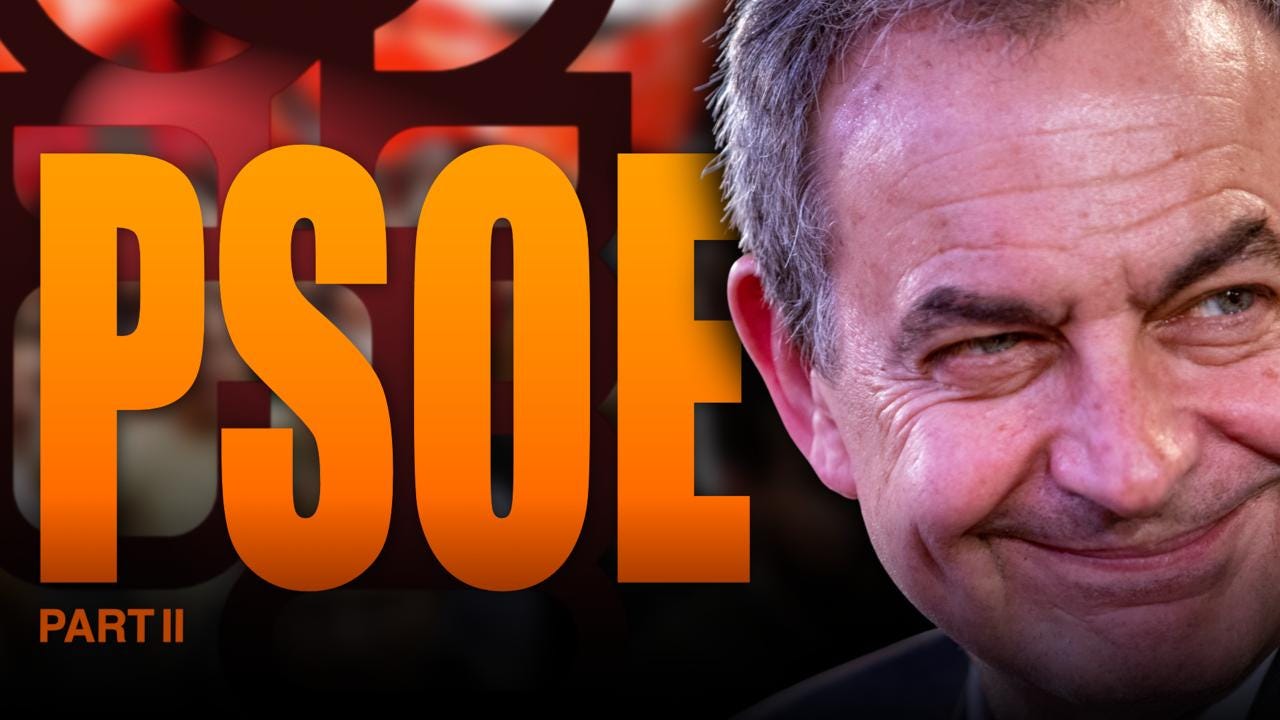
In this episode we continue our history of the PSOE, the party that has governed Spain longer than any other.
We open in Toulouse in 1974, where a party that has been in exile for almost forty years holds its thirteenth congress while Franco lies in a hospital bed. Two young Sevillians, Felipe González and Alfonso Guerra, take over an organisation funded by German social democrats and blessed in person by Mitterrand, Palme, Brandt and Michael Foot. Within five years González has stripped the word Marxism out of the party’s own doctrine, resigning the leadership to force the point and returning with almost ninety percent of the vote. In 1982 he wins 202 seats and the press calls it el rodillo, the steamroller.
Then the other half of the story. Miguel Boyer’s liberalising reforms give way to the GAL death squads, the Filesa financing conviction, the Roldán case, and a Mr X nobody ever identified. Aznar arrives in 1996, González leaves in 1997, and after a brief interregnum under Almunia and Borrell the party hands itself to an unknown professor from León.
José Luis Rodríguez Zapatero won an election nobody expected him to win, legislated same sex marriage and abortion, and rewrote how Spain is permitted to talk about its own civil war. The FAES think tank later counted eighty four separate occasions on which he denied there was an economic crisis, before unemployment reached twenty five percent and the constitution itself had to be amended. Our title comes from a hot mic on Cuatro in February 2008, when Zapatero told Iñaki Gabilondo that what suited them was for there to be tension.
We finish in 2014, with a complete unknown named Pedro Sánchez.