
Spanish Political Parties Series, Part 7 of 8
Spain goes to the polls on 29 November with card-carrying communists in its cabinet, something almost unheard of elsewhere in Western Europe, and they did not appear from nowhere. After three episodes on the PSOE, Diego and Rasheed turn to everything to its left and follow a century of splits, mergers and rebrandings, from the founding of the Partido Comunista de España at the Comintern’s insistence to Sumar, Podemos and the protest camp now occupying the Puerta del Sol.
The founding grievance against the PSOE was its appetite for power, which the communists saw confirmed when Francisco Largo Caballero took a seat on Primo de Rivera’s Consejo de Estado. Under the Second Republic the CNT and the FAI treated the new regime as too bourgeois to defend, and when three CEDA ministers entered Lerroux’s cabinet in October 1934 the left answered with the Asturias revolution, put down by an army whose operations General Franco directed in defence of the Republic’s legal order. We revisit the narrow and disputed Popular Front victory of February 1936, examined by Manuel Álvarez Tardío and Roberto Villa García, and the war within the war in Republican Catalonia that sent George Orwell home from the POUM militia to write Homage to Catalonia.
Under Franco the communists were the only opposition with a real presence inside the country, through the maquis (stood down at Stalin’s urging), the clandestine Comisiones Obreras of Marcelino Camacho, and student agitators such as Ramón Tamames, the same Tamames whom Vox put forward against Pedro Sánchez in its 2023 motion of censure. The PCE condemned the Soviet invasion of Czechoslovakia in 1968 and drifted towards Eurocommunism, and Santiago Carrillo, whose role in the Paracuellos killings of 1936 has never been settled, led the legalised party to nearly eleven per cent in 1979 before its collapse to four in 1982.
Julio Anguita, the Red Caliph of Córdoba, rebuilt that vote inside Izquierda Unida, a platform founded in 1986 in which the PCE remained the majority shareholder. His campaign against Socialist corruption drew accusations of a pinza with Aznar, and his opposition to Maastricht pushed the Nueva Izquierda faction towards the PSOE. Through Francisco Frutos, Gaspar Llamazares and Cayo Lara the space held a floor of about a million votes, and its best results always came in the years when the Socialists were collapsing.
The 15-M camps of May 2011 opened the way for a cohort of Complutense academics trained around Juan Carlos Monedero, whose CEPS foundation had advised Hugo Chávez and other Bolivarian governments. Pablo Iglesias, author of a doctoral thesis on civil disobedience and presenter of a programme on Iran’s HispanTV, and Íñigo Errejón, a close reader of Ernesto Laclau’s theory of populism, built Podemos on the language of la casta, a word that now belongs to Javier Milei. The party won 69 seats in December 2015 and absorbed Izquierda Unida, lost Errejón to Más Madrid, entered government with Sánchez in 2020, and lost Iglesias himself after he resigned the vice presidency to challenge Isabel Díaz Ayuso in the 2021 Madrid election she fought as Comunismo o libertad. Yolanda Díaz, daughter of a CCOO leader in Galicia, has since rebranded the space as Sumar, and the polls now put the two lists back where the PCE and Izquierda Unida have usually stood.
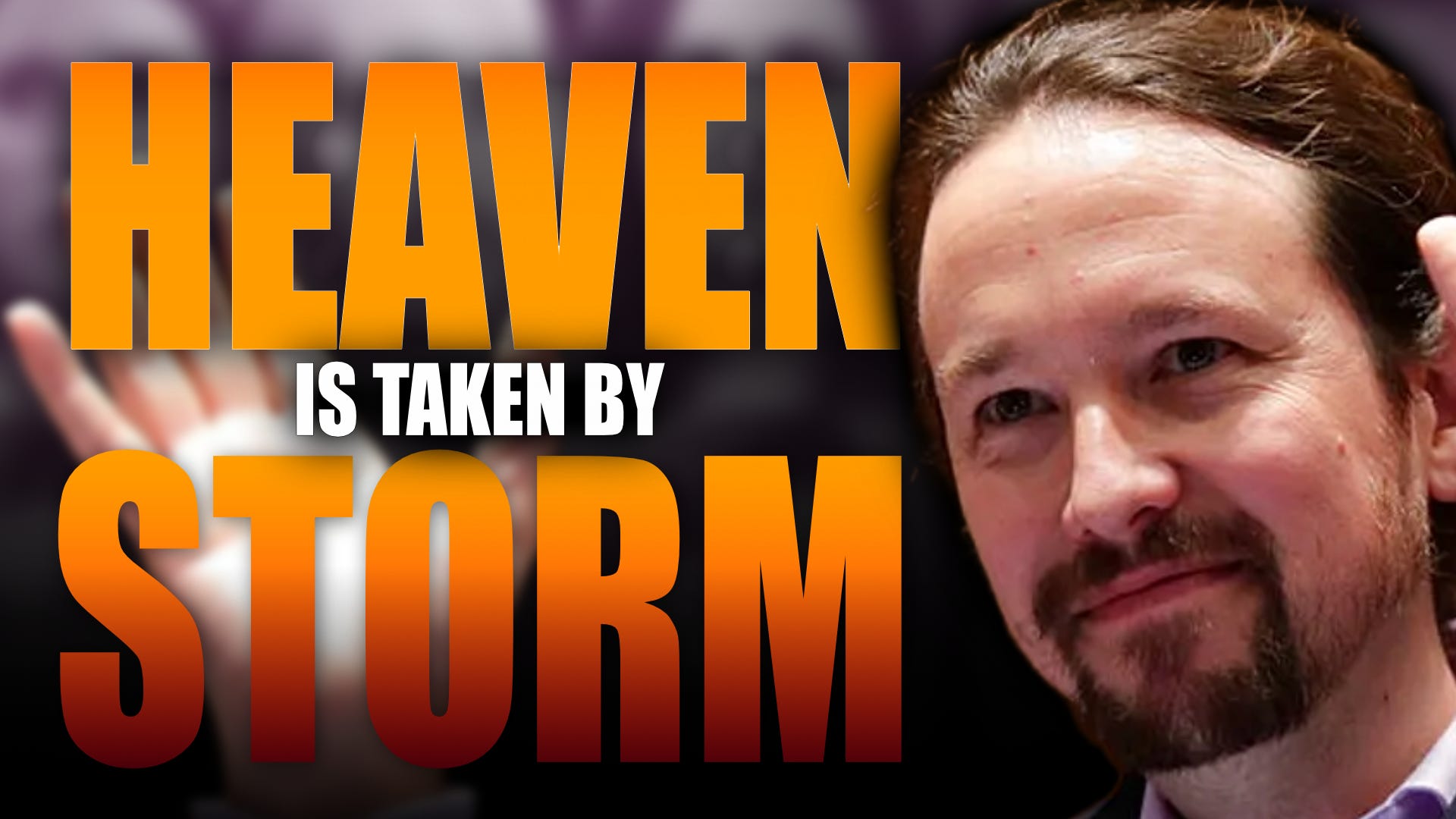
The episode ends in the present, with a camp in Sol and a CCOO and UGT general strike called weeks before the vote that, we argue, follow the 2011 playbook, and with a joint Senate list alongside the PSOE that echoes the Frente Popular ninety years on. Across that century the far left has had its moments of exuberance and has always returned to the same place, a marginal appendage of the PSOE. The title comes from Iglesias at Podemos’s founding assembly in October 2014, when he told supporters that heaven is taken by storm (el cielo se toma por asalto), a line borrowed from Marx’s letter on the Paris Commune. Next episode covers the separatist, nationalist and regionalist parties, from Catalonia and the Basque Country to the Canary Islands and Teruel Existe.